
SMART UA partners share research and good practices to advance affordable housing solutions for Ukrainian refugees
20 August 2026
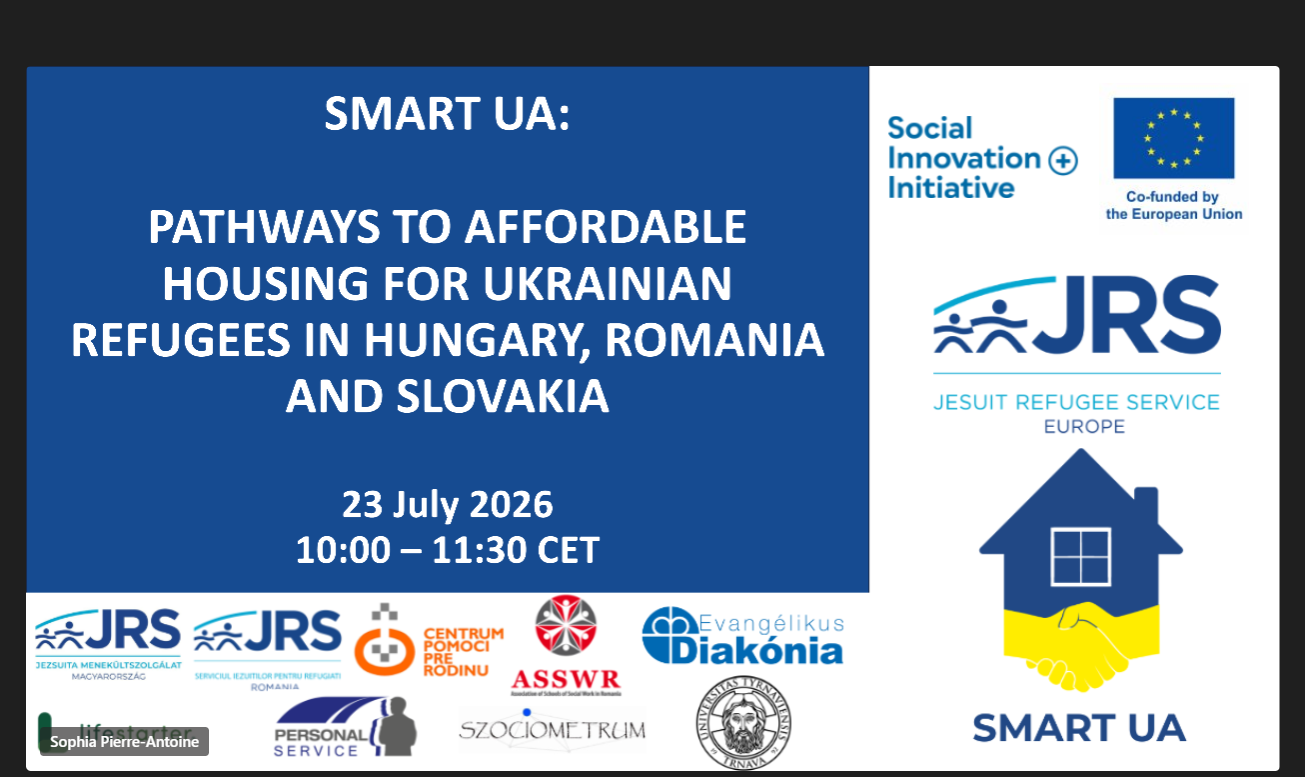
On 23 July 2026, partners of the SMART UA project came together online for the transnational meeting “Pathways to Affordable Housing for Ukrainian Refugees in Hungary, Romania and Slovakia.” The event provided an opportunity to present the latest research findings, exchange practical experiences, and reflect on sustainable approaches to improving access to housing for displaced Ukrainians across the three participating countries.
Opened by JRS Europe Regional Director Fr. Alberto Ares SJ, the meeting brought together project partners, researchers, practitioners, and stakeholders working to strengthen the social inclusion of Ukrainian refugees. The programme combined personal testimonies with presentations of national research, direct implementation experiences, and a discussion of the key lessons emerging from the project.
The meeting highlighted one of the central conclusions emerging across all three countries: housing remains one of the greatest challenges for Ukrainian refugees and requires coordinated, long-term responses rather than short-term solutions. While each national context presents unique circumstances, partners identified a common set of structural barriers, including rising rental prices, limited affordable housing, discrimination, language barriers, and fragmented support systems.
Research findings from Hungary
Researchers from Szociometrum presented the Hungarian housing analysis, based on stakeholder mapping, focus groups, refugee surveys, and validation workshops. The research explored housing barriers, cooperation among stakeholders, support needs, sustainable housing models, and policy recommendations.
The findings showed that access to affordable housing is primarily constrained by structural factors rather than individual circumstances. High rental costs, a shortage of affordable accommodation, limited public housing, restrictive eligibility criteria, language barriers, and discrimination often reinforce one another, making stable housing difficult to achieve. The research also demonstrated that financial assistance alone is insufficient. Successful housing pathways require personalised social work, mentoring, landlord mediation, legal guidance, and integrated support services that accompany refugees beyond emergency assistance.
Romania: financial pressure and the importance of trust
The Romanian presentation, led by the Association of Schools of Social Work in Romania (ASSWR), focused on stakeholder mapping, housing market analysis, and consultations with Ukrainian refugees and service providers.
The research identified financial pressure as the main obstacle to stable housing, with many refugees covering accommodation costs independently while only limited long-term institutional support is available. Additional challenges include discriminatory rent increases, informal rental agreements that prevent access to public services, and uncertainty surrounding the future of Temporary Protection. Researchers also highlighted that trust, community relationships, and Ukrainian-speaking staff play a decisive role in ensuring meaningful engagement with refugee communities.
Slovakia: from emergency accommodation to long-term housing
Partners from the Family Help Center (CPPR) and Trnava University presented findings from Slovakia, where refugee needs have shifted significantly since the beginning of the displacement crisis.
Research showed growing demand for stable rental housing, particularly in Bratislava and other economic centres, while vulnerable groups such as single-parent families, older people, and persons with disabilities continue to face the greatest challenges. Participants identified high rental costs, language barriers, legal uncertainty, discrimination, and limited family-sized housing as key obstacles. The analysis also stressed the importance of stronger coordination between public authorities, NGOs, employers, and local communities, alongside greater investment in integrated housing models supported by European funding.
Turning research into practical support
Beyond research, partners showcased how the SMART UA project is already translating evidence into concrete support for Ukrainian refugees:
- JRS Hungary presented housing training sessions covering tenants’ rights, available housing support, property purchasing, and financial literacy, alongside individual housing consultations, stakeholder engagement, and community activities. More than 100 Ukrainian beneficiaries have already participated in specialised housing training, while tailored consultations have supported over 50 households.
- JRS Romania shared similar initiatives, including face-to-face and online housing training delivered together with public institutions and private sector partners, awareness campaigns, national stakeholder workshops, and personalised consultations that have reached more than 100 households.
Throughout the meeting, partners underlined that effective housing support goes beyond financial assistance. Long-term stability depends on combining housing support with legal guidance, social accompaniment, employment pathways, language learning, and close cooperation between public institutions, civil society organisations, researchers, and local communities.
The meeting concluded with a shared commitment to continue transforming research into practical recommendations and evidence-based actions that strengthen access to affordable housing and support the long-term inclusion of Ukrainian refugees across Hungary, Romania, and Slovakia.
Co-funded by the European Union. Views and opinions expressed are, however, those of the author(s) only and do not necessarily reflect those of the European Union or the European Social Fund Agency. Neither the European Union nor the Granting Authority can be held responsible for them.